
The personality assessment you'll actually remember (and use)
True Tilt builds on Jung and Myers-Briggs—but transforms abstract letters into a visual, memorable framework modern leaders actually apply every day.
Over 10,000 5-Star Reviews
Most people can't remember their MBTI type six months after taking it. And what we don't remember, we don't use.
Six Fundamental Flaws (And How Tilt Fixes Them)
Nobody Remembers Their Type
Four abstract letters (ENFP, ISTJ) with psychological terminology that don't stick in memory or translate to daily decisions.
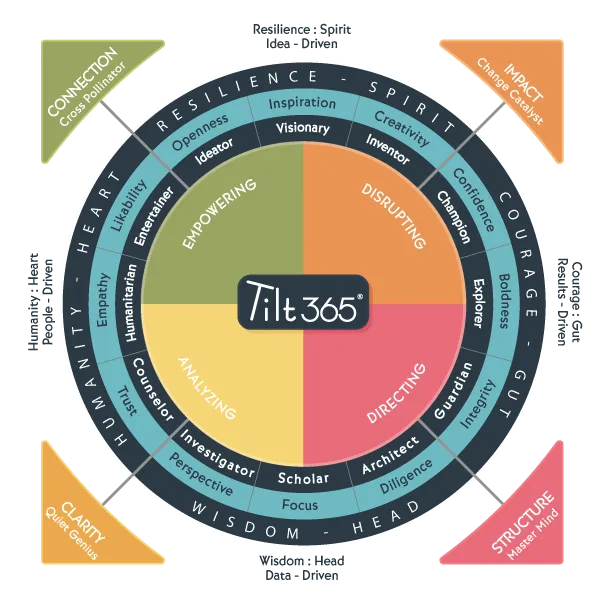
Four visual, memorable patterns with business-relevant names:
- IMPACT (The Change Catalyst) - Driving change through bold ideas
- CONNECTION (The Cross-Pollinator) - Building influence through collaboration
- CLARITY (The Quiet Genius) - Creating alignment through analysis
- STRUCTURE (The Mastermind) - Delivering results through execution
Psychological Jargon vs. Business Language
Terms like "Extraverted Intuition" require translation. What does "Judging" mean in business?
Language leaders already use: Idea-Driven vs. Data-Driven. Results-Driven vs. People-Driven. These are actual business conversations.
16 Types Are Impossible to Retain
Cognitive overload. Even certified practitioners struggle to remember all 16 types and interactions.
Four primary patterns—the sweet spot. Simple to remember, sophisticated enough to be useful, practical enough to apply immediately.
Typing Creates Boxes, Not Growth
"I'm an INTJ, so I'm not good with people." Personality becomes an excuse rather than a development roadmap.
Built on the Polarity Principle: You need BOTH sides to be agile. Shows you which patterns to develop, not which box you're in forever.
One-Size-Fits-All Introversion/Extraversion
You're globally introverted OR extraverted. But reality is far more nuanced—social preference varies by what you're sharing AND your comfort with social risk.
Each of the four parts of yourself (Head, Heart, Gut, Spirit) has three sub-preferences for social risk:
- Reserved - One-to-one: Comfortable sharing with one person at a time
- Selective - One-to-some: Comfortable with small groups of like-minded people
- Expansive - One-to-many: Comfortable with large audiences or public settings
You might be Expansive with bold ideas, Reserved with emotions, Selective with decisions. That's 12 different social risk profiles—not one global label.
No Concept of Overuse or the Golden Mean
MBTI tells you what you prefer, but not when your preferences become excessive. No concept of moderation, balance, or self-regulation. If you're "high Thinking," it doesn't warn you when logic becomes cold analysis that alienates your team.
Tilt introduces Aristotle's Golden Mean to personality assessment. Every strength has three states:
- Underuse (1-3) - Deficiency: The strength is underdeveloped
- Agile Zone (4-7) - Golden Mean: Optimal, flexible use
- Overuse (8-10) - Excess: The strength has become counterproductive
Example: Inspiration at 8.75 = Your visionary energy overwhelms others. Build Focus (its polar opposite) to naturally restore balance. This enables self-regulation through polarity, not suppression.
One Look. Forever Remembered.
Unlike MBTI's abstract letters, Tilt uses a circular visual model with four clear quadrants. Once you see it, you remember it. Once you remember it, you use it.
Each quadrant represents a distinct way of creating value:
MBTI vs. True Tilt: What Actually Works
"Six months after MBTI, I couldn't remember my type. Six months after Tilt, I was using it daily to understand my team, improve my leadership, and navigate difficult conversations. The difference? I actually remembered it."
Ready for a Personality Assessment You'll Actually Use?
Discover your Tilt, understand your growth edges, and get a practical development roadmap—not just a four-letter type you'll forget.
Take the True Tilt Assessment →