What Team Dynamics Really Are (And Why Most Teams Get Them Wrong)
You can usually feel it before you can name it.
The team has the right people. The strategy is sound. The work is getting done — but slowly, with more friction than it should take.
Decisions get re-litigated. The same two people clash in every meeting. Talented contributors go quiet. Someone you trusted to lead a piece of work is suddenly the bottleneck.
From the outside it looks like a performance problem. From the inside it feels like something harder to diagnose: a team that should be working isn't quite working.
This is what team dynamics actually means. Not the soft, abstract phrase it has become — but the real, observable patterns that decide whether your team compounds or stalls.
What Are Team Dynamics?
Team dynamics are the patterns of interaction that shape how a team makes decisions, handles conflict, distributes work, and adapts under pressure.
They include:
-
How people communicate
-
How they respond to disagreement
-
How trust is built or eroded
-
How collective strengths show up under stress
Strong team dynamics produce:
-
Speed
-
Candor
-
Adaptability
-
Healthy conflict
-
Better execution
Weak team dynamics produce the opposite:
-
Slow decisions
-
Hidden disagreement
-
Work-arounds
-
Burnout
-
Quiet attrition from top performers
The most important thing to understand is this:
Team dynamics are not about personality fit. They are about what happens to a team’s character strengths under stress.
The Pattern Most Leaders Miss
When a team starts to struggle, most leaders instinctively look for the weak link.
Who is underperforming?
Who is causing friction?
Who needs to be coached, replaced, or moved?
That instinct is usually wrong.
In high-performing organizations, the people creating the most friction are often the strongest contributors.
-
The Change Catalyst who drives momentum starts pushing too hard
-
The Cross Pollinator who builds bridges starts avoiding hard truths
-
The Master Mind who brings rigor starts shutting down input
-
The Quiet Genius who anticipates risk starts slowing every decision in pursuit of certainty
Each of these is a genuine strength pushed into its extreme.
Under pressure, the ego does not invent new behavior. It doubles down on the behavior that has worked before.
The very strength that defines a person becomes the thing that erodes the team.
This is why surface-level interventions rarely work.
A communication workshop will not fix a team where each member’s ego is silently defending against an unconscious fear.
A new RACI chart will not solve a team whose default patterns are working against its own goals.
The team does not need new behaviors layered on top.
It needs to understand what is already driving the behaviors it has.
Four Patterns That Shape Every Team
Most teams contain a mix of four character orientations:
| Character Pattern | At Its Best | At the Extreme |
|---|---|---|
| Impact — the Change Catalyst | Drives momentum, makes bold calls, creates urgency | Pushes too hard, mistakes speed for progress |
| Clarity — the Quiet Genius | Anticipates risk, thinks deeply, prepares thoroughly | Over-prepares, becomes risk-averse, slows decisions |
| Connection — the Cross Pollinator | Builds bridges, includes the right voices | Prioritizes harmony over decision-making |
| Structure — the Master Mind | Builds efficient systems and clear execution | Becomes rigid and shuts out input |
Where Real Team Conflict Comes From
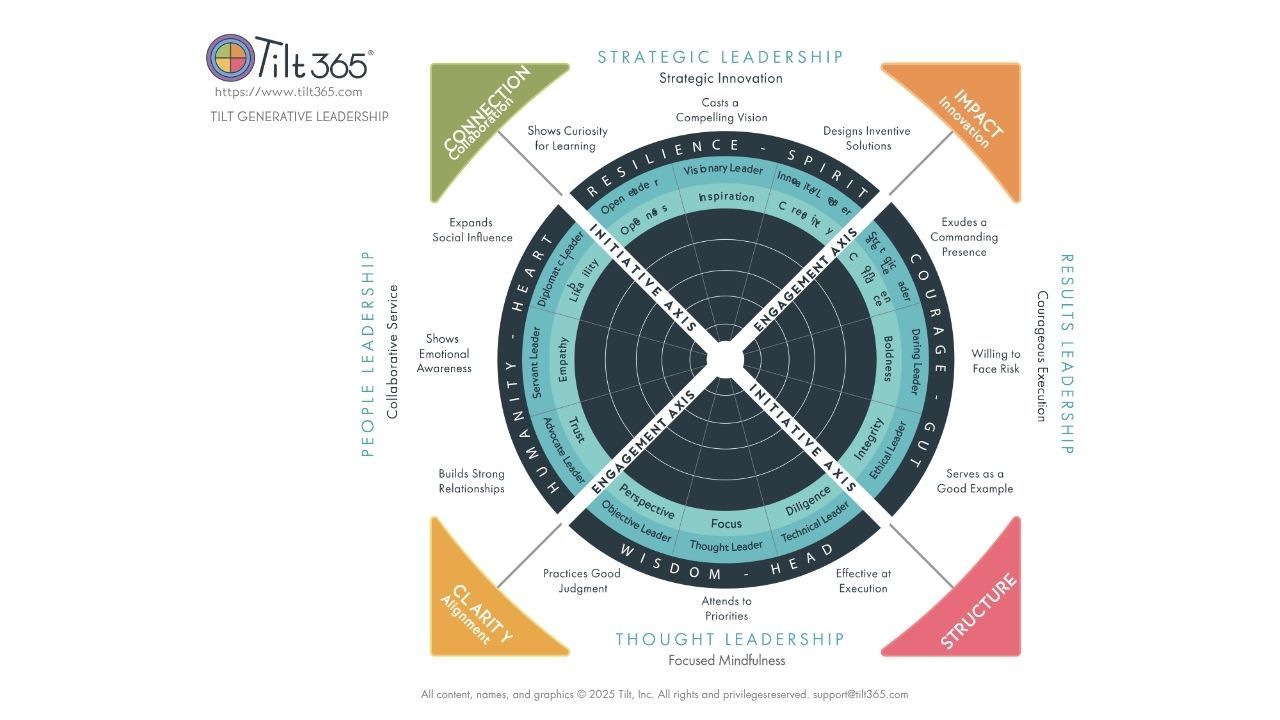
[INSERT VISUAL: Tilt365 Generative Model]
Use the current branded version of the Generative Model showing the four character patterns and sub-personas.
Each pattern has an opposite.
The conflicts that derail teams happen at the diagonals of the framework — between people whose strengths sit at opposite corners.
Impact vs. Clarity
The Change Catalyst feels urgency and wants to move.
The Quiet Genius sees risk and wants to prepare.
At their best, they balance each other:
-
Momentum + thoroughness
-
Speed + thoughtfulness
At their extremes:
-
The Change Catalyst sees the Quiet Genius as a brake
-
The Quiet Genius sees the Change Catalyst as reckless
Both are overusing the strength that defines them.
Connection vs. Structure
The Cross Pollinator wants inclusion, collaboration, and influence.
The Master Mind wants efficiency, ownership, and execution.
At their best:
-
One creates buy-in
-
One creates clarity
At their extremes:
-
The Cross Pollinator experiences the Master Mind as cold and rigid
-
The Master Mind experiences the Cross Pollinator as scattered and inefficient
The issue is not personality.
The issue is what happens when unconscious fear pushes a strength into its extreme.
-
Fear of being wrong
-
Fear of losing control
-
Fear of exclusion
-
Fear of irrelevance
The strength itself is not the problem.
The fear underneath it is.
Why “Personality Conflicts” Are Rarely About Personality
When two team members consistently clash, people often label it a “personality conflict.”
That framing is misleading.
What is actually happening is usually this:
Two character strengths sit at opposite corners of the framework, and both are operating from fear.
For example:
-
A Change Catalyst whose fear of being left behind turns urgency into pressure
-
A Quiet Genius whose fear of being wrong turns preparation into paralysis
Or:
-
A Cross Pollinator whose fear of exclusion turns inclusiveness into diffusion
-
A Master Mind whose fear of losing control turns efficiency into rigidity
The conflict is real.
But the framing matters because “personality conflict” suggests the problem lives inside the people themselves.
In reality, the problem lives in the fears underneath the behavior — and in the fixed mindsets that keep people locked in the extreme.
This is why static personality labels often make team dynamics worse over time.
They give people an identity to hide behind:
“That’s just how I am.”
What teams actually need is:
-
A shared language
-
Awareness of stress patterns
-
The ability to recognize extremes in real time
-
The agility to flex back to productive behavior
What Functional Leaders Should Actually Measure
If you lead a function — sales, operations, engineering, finance, clinical, customer success — stop relying solely on engagement scores.
Measure these instead:
1. Decision Speed
How long does it take from:
“We should decide this”
to:
“We have decided this”
Slow decisions are almost always a team dynamics issue.
2. Disagreement Surface Area
Are the real disagreements happening in the room?
Or afterward in Slack threads, side conversations, and hallway discussions?
Hidden disagreement is one of the most expensive forms of friction.
3. Recovery Time After Conflict
Healthy teams experience tension and move through it.
Unhealthy teams carry it for weeks.
4. Cross-Functional Reputation
How does your team show up to other teams?
The dynamics you cannot see internally are often obvious externally.
5. Voluntary Contribution
Are people bringing their best thinking?
Or just doing their jobs?
The gap between those two things is the cost of poor team dynamics.
Common Questions Leaders Ask
How do personality differences affect team dynamics?
Differences become problematic when stress pushes strengths into their extremes.
The differences themselves are not the issue.
In fact, they are often what make great teams possible.
How can leaders improve team dynamics without labeling people?
Focus on:
-
Observable behavior
-
The fear underneath the behavior
-
The agility to return to productive patterns
The goal is not typing people.
The goal is awareness.
What is the “storming” stage?
Storming is the predictable phase where team differences create friction.
Most teams either:
-
Avoid it entirely and stay shallow
-
Get stuck in it and stay dysfunctional
Teams move through it faster when they understand why the friction is happening.
What is character agility?
Growth mindset is the belief that people can grow.
Character agility is the real-time ability to:
-
Recognize when ego has shifted into an extreme
-
Name the fear underneath it
-
Choose a different response
Mindset is the belief.
Agility is the behavior.
How do teams sustain improvement after a workshop?
They don’t sustain it through a workshop alone.
They sustain it through:
-
Ongoing reflection
-
Shared language
-
Observation
-
Feedback
-
Practice
The teams that improve are the ones that build these habits into how they operate.
The Tilt365 Point of View
Most team development approaches treat personality as fixed and behavior as something to coach around the edges.
Tilt365 approaches it differently.
We start with the strengths your team already has.
Then we help make the patterns visible.
Most importantly, we help individuals recognize:
-
Their stress reactions
-
The fears driving them
-
The moments when strengths move into extremes
That self-awareness changes everything.
When people understand their tendencies under pressure, they recover faster.
They stop getting hijacked by patterns they could not previously name.
And the team gains something most teams never achieve:
The ability to move through conflict in minutes instead of carrying it for weeks.
The result is not just a more harmonious team.
It is a more capable one.
A team that:
-
Moves faster
-
Disagrees productively
-
Adapts under pressure
-
Makes better decisions together
That is what team dynamics are supposed to do.
Talk to Us
If you are leading a team that should be performing better than it is, the conversation is worth having.
Tilt365 works with functional leaders across healthcare, financial services, government, and enterprise organizations to make team dynamics visible, measurable, and changeable.
[Book a 30-Minute Discovery Call →]
We’ll spend the time on your team — not our pitch.