
Why 360 Feedback is Being Replaced by the Tilt365 Agility Growth Tracker
Jan 18, 2026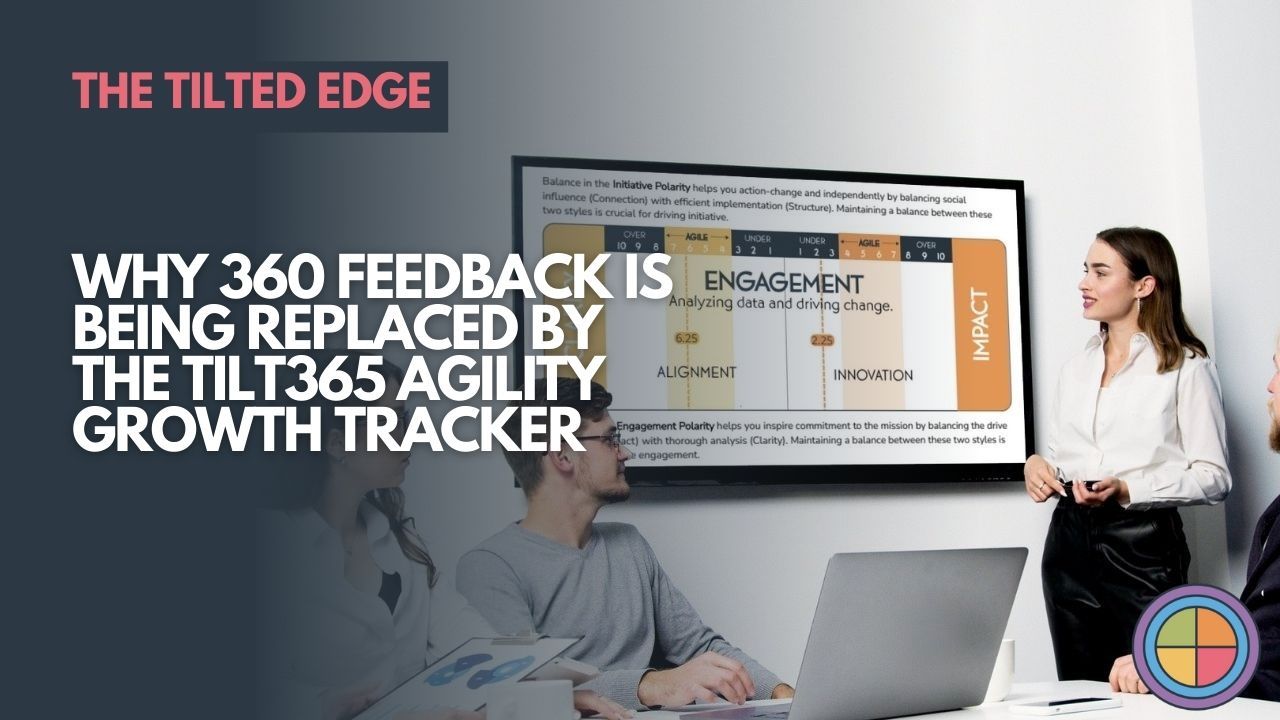
Written by Pam Boney, Founder & CEO
For decades, organizations have relied on 360-degree feedback processes or assessments to measure leadership capability and drive personal growth. The method promised a holistic view with insights collected from peers, subordinates, and supervisors that would reveal blind spots and open pathways to development.
Yet growing evidence shows that traditional 360s often fall short of that promise. They are labor-intensive, emotionally triggering, and heavily influenced by bias and projection, resulting in data that reflects more about how others feel than who the individual truly is.
Forward-thinking organizations are replacing opinion-based systems with tools grounded in validated identity science. Tools such as the Tilt365 Agility Growth Tracker, which enables leaders to grow through measurable self-awareness and emotional agility rather than external evaluation.
The Hidden Problems with Traditional 360 Feedback
1. Feedback Triggers Ego-Fear, Not Growth
Behavioral research shows that humans are neurologically wired to defend against threats to the ego. When individuals fear being judged — emotions like “I’m not enough,” “I’m not accepted,” “I’m not seen,” or “I’m not in control” — the brain automatically shifts into protection mode (Rock, 2008). Traditional 360 processes, by design, amplify these fears by inviting criticism and comparison, which often sparks defensiveness rather than openness.
Instead of fostering reflection, the process can deepen anxiety and self-protection, undermining psychological safety (Edmondson, 1999) and reducing the quality of learning conversations that lead to authentic growth.
2. 360s Measure Likability More Than Leadership
New studies reveal an even deeper flaw: 360-degree feedback tends to measure interpersonal likability rather than true capability. Research on the halo effect, a cognitive bias in which one positive trait influences ratings on unrelated traits (Thorndike, 1920; Nisbett & Wilson, 1977), shows that raters unconsciously give higher scores to people they like, admire, or find relatable.
A 2022 meta-analysis of rater bias in performance appraisals (Borman et al., 2022) reinforces this pattern: most 360 ratings are statistically correlated with relational affinity, suggesting they reflect social perception rather than developmental potential. As a result, 360-degree feedback typically reports one dominant variable: how much someone is liked, not how much they have grown.
3. Bias and Projection Distort the Mirror
Classic research in psychology confirms that humans are prone to projection bias, unconsciously attributing one’s motives, standards, or insecurities onto others (Freud, 1915; Holmes, 1968). In 360 systems, this means that what peers see in others often reflects themselves.
Because of this, 360 data lacks objectivity. Differences across raters are not necessarily inconsistencies in behavior; they are differences in the observer’s mind. That makes 360 results an aggregation of perceptions, not a measured view of actual identity or capability.
The Science of Identity: Why Self-Perception Leads the Way
The principle underlying the Tilt365 Agility Growth Tracker is simple but profound: how others see us begins with how we see ourselves.
Decades of self-concept research confirm that self-belief shapes behavior, which in turn shapes others’ perceptions (Shamir & Eilam, 2005; Owens et al., 2013). When individuals believe they are competent, whole, or capable of change, they naturally communicate that belief — verbally, nonverbally, and emotionally. Others perceive and reinforce it.
Thus, the most powerful way to change external perception is to change internal identity narratives. The Agility Growth Tracker helps individuals consciously observe and rewire these identity patterns through continuous, data-driven reflection — building evidence-based self-awareness that directly translates into behavioral agility and stronger leadership presence.
A Science-Backed Alternative to Opinion Loops
The Tilt365 Agility Growth Tracker eliminates the need for subjective third-party evaluation by measuring development through a validated character and agility framework. The model draws from character science, validated psychometrics, and the psychology of conscious leadership.
Unlike 360 workflows, which deliver insights months later, Tilt365’s system operates in real time, continuously tracking how a leader’s inner mindset evolves and how that evolution influences outward agility. The result is actionable, longitudinal data that measures authentic identity growth, not fleeting reputation impressions affected by recent context.
The Benefits of Transitioning from 360 to Tilt365
- Scientifically Validated Framework: Built on identity science and character research instead of perception aggregation.
- Real-Time Insight: Measures continuous growth and agility in dynamic environments.
- Bias Reduction: Removes projection and halo distortions inherent in peer ratings.
- Psychological Safety: Creates a curiosity-based self-reflection process rather than a threat-based evaluation.
- Empowered Transformation: Helps users shift self-beliefs, the most direct way to influence how they are perceived by others.
The Future of Feedback Is Self-Awareness
The traditional 360-degree feedback model served its purpose in an earlier era of corporate development. But new science shows that the path to agility and leadership excellence lies in transforming identity rather than gathering opinions.
The Tilt365 Agility Growth Tracker embodies this evolution: a scientifically grounded method that reframes development as an inward journey of conscious awareness and character growth.
As emerging research continues to confirm, sustainable change doesn’t begin with how others see us — it begins with how we see ourselves.
References
- Borman, W. C., et al. (2022). Rater bias and reliability in performance appraisals: A meta-analytic review. Journal of Applied Psychology, 107(4), 652–669.
- Edmondson, A. C. (1999). Psychological safety and learning behavior in work teams. Administrative Science Quarterly, 44(2), 350–383.
- Freud, S. (1915). Repression. Standard Edition of the Complete Psychological Works of Sigmund Freud.
- Holmes, D. S. (1968). Dimensions of projection. Psychological Bulletin, 69(4), 248–268.
- Nisbett, R. E., & Wilson, T. D. (1977). The halo effect: Evidence for unconscious alteration of judgments. Journal of Personality and Social Psychology, 35(4), 250–256.
- Owens, B. P., Johnson, M. D., & Mitchell, T. R. (2013). Expressed humility in organizations: Implications for performance, teams, and leadership. Organization Science, 24(5), 1517–1538.
- Rock, D. (2008). SCARF: A brain-based model for collaborating with and influencing others. NeuroLeadership Journal, 1(1), 44–52.
- Shamir, B., & Eilam, G. (2005). “What’s your story?” A life-stories approach to authentic leadership development. The Leadership Quarterly, 16(3), 395–417.
- Thorndike, E. L. (1920). A constant error in psychological ratings. Journal of Applied Psychology, 4(1), 25–29.
Stay connected with news and updates!
Join our mailing list to receive the latest news and updates from our team.
Don't worry, your information will not be shared.
We hate SPAM. We will never sell your information, for any reason.